

Antique Four Drawer Chest Of Drawers

England. Circa 1820.
English Regency chest of drawers in figured mahogany with four graduated drawers. and ebony stringing to the top, drawer fronts and apron. Fluted columns end in turned and beaded feet.. Beaded top edge and apron.
Regency Mahogany Chest of Drawers

United Kingdom. 18th century.
Stately George II walnut burr chest on stand with scalloped apron situated on cabriole legs. Fine example of 18th century craftsmanship. Oak lined drawers and original brass.
George II Walnut Chest on Stand

China. Circa 19th century.
This chest is constructed primarily of pine, but the recessed front panels appear to be cherry burl. A beautiful, rich patina is what draws the eye to this chest; the warm hue of the brass trim and hardware only enhances this effect.
Chinese Chest on Stand

England. Circa 1810.
This is a beautiful walnut five drawer chest with quartered, cross banded top, waterfall veneered front with boxwood stringing on drawer fronts. The replaced Chippendale style brasses do not detract from the classic appearance of this quality chest of drawers.
George III Walnut Five Drawer Chest

England. Circa 1890.
This is a handsome, oak four drawer Jacobean style chest on bracket feet. Two shallow drawers and two deep drawers alternate down the case while and octagonal recessed panel on each side completes the authentic look of this 19th century re-imagining of a Jacobean chest.
Oak Jacobean Style Chest

England. Circa 1830.
Solid camphor wood campaign chest in two parts and resting on turned feet. Sturdy construction with deep dovetailing and inset, flush mounted brass pulls. Ebonized stringing decorates each drawer front. Prized for its moth-repellant qualities, camphor wood -- a native Chinese species of evergreen -- was frequently used in the construction of sea chests. This particular example of campaign chest was probably produced in a busy harbor town or city.
Solid Camphor Campaign Wood Chest

England. Circa 1860.
This large chest of drawers in original paint retains its original knobs. An exercise in frivolity, it was originally a country piece dressed up slightly with a dark umber cross banding contrasting the gold and amber field that covers the rest of the case. However, the years have brought this chest past its humble beginnings and it would look beautiful juxtaposed with some of today's interiors with their modern lines and sparse décor.
Painted Three Drawer Chest

England. Circa 1770.
With its double string inlay of boxwood and handsome brasses, this antique bachelor's chest has just the right panache to look good in a bedroom, or as an end table out in the public living room. Its depth of 18" doesn't preclude it from duty in a front hall, either. The top has matching string inlay, but that inlay is not repeated on the utilitarian oak, pull out brush slide, which bears the scars of repeated cigarette burns and ink stains.
Inlaid Mahogany Bachelor's Chest

England. Circa 1810.
This mahogany chest with four graduated drawers and bracket feet has a deep cross banding of mahogany on the top and boxwood stringing to accent both the top and drawer fronts. Solid brass bail pulls, while difficult to determine if original, are very much of the period.
Mahogany Bachelor's Chest

England. Circa 1800.
This large oak chest has four graduated drawers with unique panels for each drawer. Technically not a period Jacobean piece, it still faithfully hews the line with its sturdy construction, geometric paneling and bun feet. Its substantial size offers plenty of storage to go with its outsized appearance.
Large Jacobean Chest of Drawers
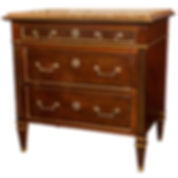
France. Circa 1880.
Created at the end of the 19th century in the fashion of 100 years prior, this commode employs a fascinating mahogany referred to as "plum pudding" because of its wild, undulating grain. Attractively trimmed in brass and topped with a lively salmon marble, this commode features unique proportions that make it a little boxier than its period cousins, thus offering a classic look in a modern shape.
French Commode with Salmon Marble

England. Circa 1800.
With its useful brush slide and handsome canted corners, this chest offers a good amount of storage space in a compact design. Four broad, graduated drawers ease the eye down to the tall bracket feet that keep the proportions from looking too compact and bring the height to a comfortable 33 ½ inches.
Mahogany Canted Corner Chest

England. Circa 1880.
Not your garden-variety bow front chest (who would put a mahogany chest in the garden?), this chest has a string, contrasting band of satinwood the envelopes the top edge and string inlay on the drawer fronts. A traditional arrangement of two small drawers over three graduated drawers allows for ample storage in a chest with deeply grained mahogany and a distinct visual appeal.
Mahogany Bow Front Chest

France. Circa 1890.
Remarkable parquetry inlay work defines this mahogany and kingwood commode. A beautifully mottled marble top, block front, and deeply chamfered front corners are welcome design elements that give this commode a handsome profile. With brass ring pulls and ornate escutcheons, it presents a formal visage that would look just as well in a drawing room on Central Park West as it would at the palace at Versailles.
Parquetry Inlaid Commode

United Kingdom. 19th century.
Two-piece English teak campaign chest of drawers with brass handles on upper and lower sections. Chest rests on replaced bun feet.
English Teak Campaign Chest
Antique Four Drawer Chest Of Drawers
Source: https://www.millhouseantiquesandgardens.com/antiquechests
Posted by: santiagomideed1982.blogspot.com
0 Response to "Antique Four Drawer Chest Of Drawers"
Post a Comment